





Eye For Film >> Movies >> La Place (2026) Film Review


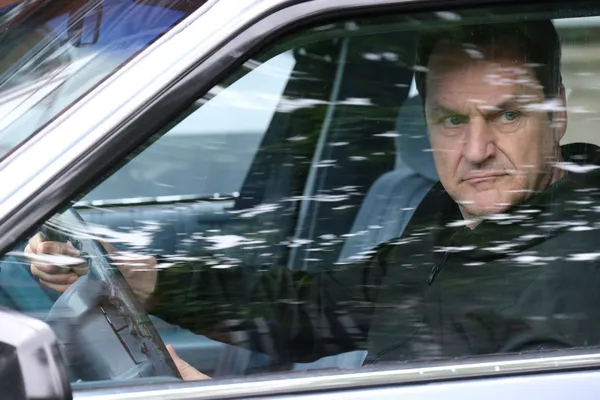

If you take old age and the Covid pandemic out of the equation, the overwhelming majority of dangerous situations that ordinary people in relatively high income countries get into happen on the roads. Behind the wheel of a vehicle any one of us can be dangerous and almost anyone can be vulnerable. Only the law and tacit social conventions exist to keep us from barbarity, and this is the context in which that is clearest. Most people manage to control their tempers most of the time, but it’s not only in traffic that they can threaten to boil over – it’s also when finding somewhere to park.
French Canadian thriller La Place, which screened as part of the 2026 Fantasia International Film Festival, follows troubled couple Brigitte (Christine Beaulieu) and Joe (Maxim Gaudette) as they drive into town to attend a dinner party at the home of her sister Sonia (Alexa-Jeanne Dubé). They chat as they drive, but things are tense, and there’s an underlying sadness between them; they have been try and failing to have a child. There’s a sense that Joe feels emasculated by this. Perhaps that’s why, when they finally spot a parking space right in front of Sonia’s home, only to have it blocked by another driver (Benoît Gouin), he is initially passive. It is Brigitte who steps up, initially trying to be nice about it, hoping to persuade the driver to give way.

The driver refuses, and insists on speaking to her husband. What may seem to be irritating but commonplace sexism hides something deeper, however, as gender becomes a major factor in the ensuing events.
“We never truly know what’s happening until it’s happened,” says the driver.
Violence is always lurking at the edge of the narrative. Even before the parking incident, when he and Brigitte are discussing the news, Joe mentions a news story about a six-year-old girl kidnapped from a petrol station. Later, a male police officer checks in, to reassure himself, on his own two young daughters. His female colleague does not understand his decisions at the scene. Brigitte’s car is deliberately bumped, and that’s not the only road accident we witness directly. The hostile driver is relentlessly petty and uncooperative, simply refusing to respect social norms, creating a situation in which escalating aggression is the only alternative to surrender. It is very much a story for our times, and in proper French fashion, events are subsequently discussed and analysed over dinner – but despite what most of the diners think, the conflict is not over.
The emotional logic of La Place will make absolute sense to some viewers and be inscrutable to others, though that inscrutability is acknowledged and given space in the conversation. Accordingly, you might experience it as an intense and relatable psychological thriller or as a mystery with a confounding conclusion. Visually, director Louis Godbout contrasts the warm softness of Sonia’s apartment and Brigitte’s nest-like country home, a cottage wrapped in foliage, with the hard, straight lines and smooth surfaces of the city and the road itself. They become intersecting worlds, no longer part of the same thing. That the driver understands this clearly is one of the sources of his power. But if another of the characters should come to that understanding, what would it mean?
In reinforcing old ideas, this is a less radical work than it might first appear, but it makes its case well within the limits of this artificial scenario. Critically, Godbout’s ability to convincingly sustain the narrative beyond the localised point of conflict makes the film work not only as an allegory but also as a parable of sorts, whilst shifting the locus of tension and giving viewers a chance to breathe. This lets the film itself move beyond mere bludgeoning and make use of a broader tool set to get its message across. It makes room for that sweet strain of melancholy which can emerge when we recognise what is already lost.
Reviewed on: 07 Aug 2026


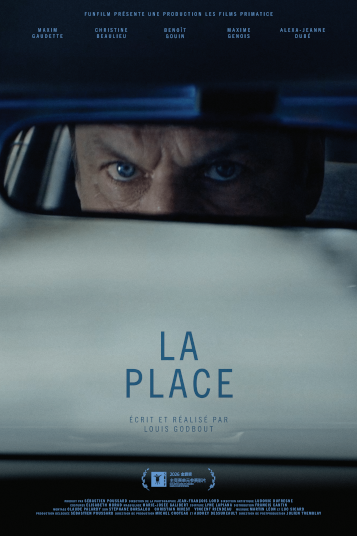
Director: Louis Godbout
Writer: Louis Godbout
Starring: Christine Beaulieu, Domenic Di Rosa, Alexa-Jeanne Dubé, Maxim Gaudette, Maxime Genois
Year: 2026
Country: Canada
Search database:
